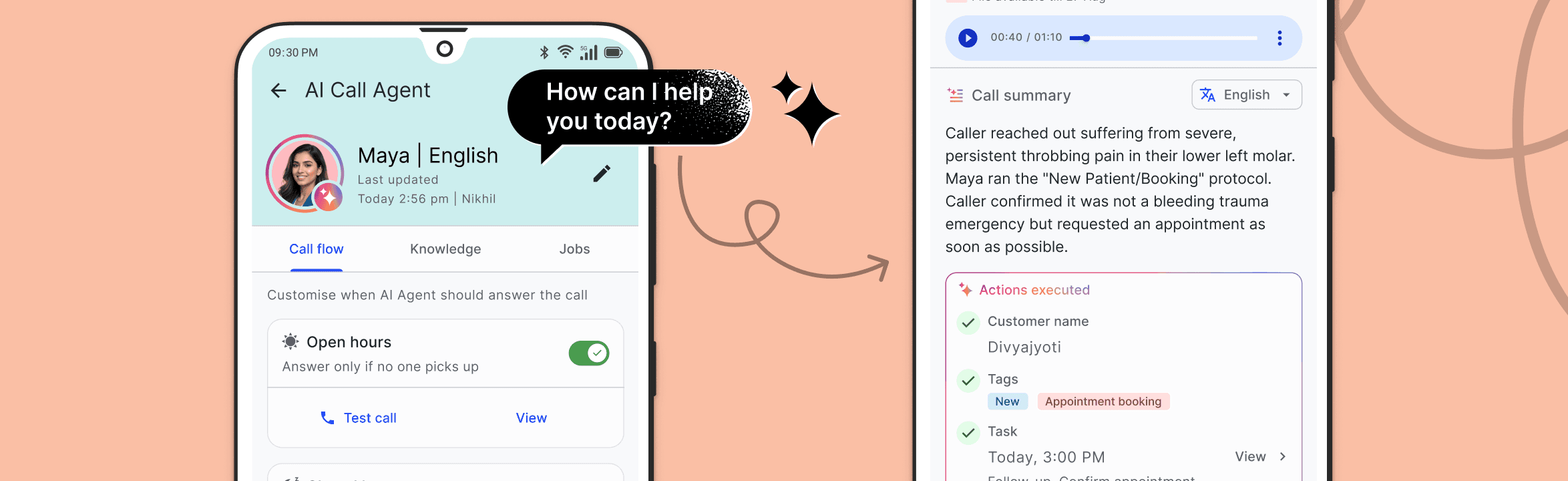
An AI call agent for non-technical business owners
An AI call agent for non-technical business owners
A design solution for small business owners to set up an agent and manage like a member of their team.
A design solution for small business owners to set up an agent and manage like a member of their team.
My role
Owned end-to-end design from problem framing through final QA.
Worked closely with the co-founder on product strategy and direction
Owned all UX-side technical decisions
Influenced the reframing of the problem and the key design decisions.
Ran design critiques with cross-functional stakeholders
Took an active role in QA, including adversarial testing of AI outputs
Partnered with engineering through implementation
SUPERFONE
Lead Designer
2025
04 weeks
concept → launch
mobile
android
live in prod
Context
Context
Superfone gives SMBs a virtual phone number their whole team can share
Superfone gives SMBs a virtual phone number their whole team can share
For many businesses, including manufacturing, travel agencies, and design studios, phone calls are crucial. A ringing phone signals a potential customer, while missed calls can lead to lost business. Calls are often missed after hours, on weekends, or when staff are busy.
This case study explores the implementation of an AI call agent that answers when the team cannot. It handles routine inquiries and directs callers to a human representative when necessary. The study outlines how the agent was integrated into the team, how owners defined its capabilities, and how they retain control over calls, designed for those unfamiliar with automation.
For many businesses, including manufacturing, travel agencies, and design studios, phone calls are crucial. A ringing phone signals a potential customer, while missed calls can lead to lost business. Calls are often missed after hours, on weekends, or when staff are busy.
This case study explores the implementation of an AI call agent that answers when the team cannot. It handles routine inquiries and directs callers to a human representative when necessary. The study outlines how the agent was integrated into the team, how owners defined its capabilities, and how they retain control over calls, designed for those unfamiliar with automation.
state of a missed call
state of a missed call
When no one is available to take a call, it gets missed
When no one is available to take a call, it gets missed
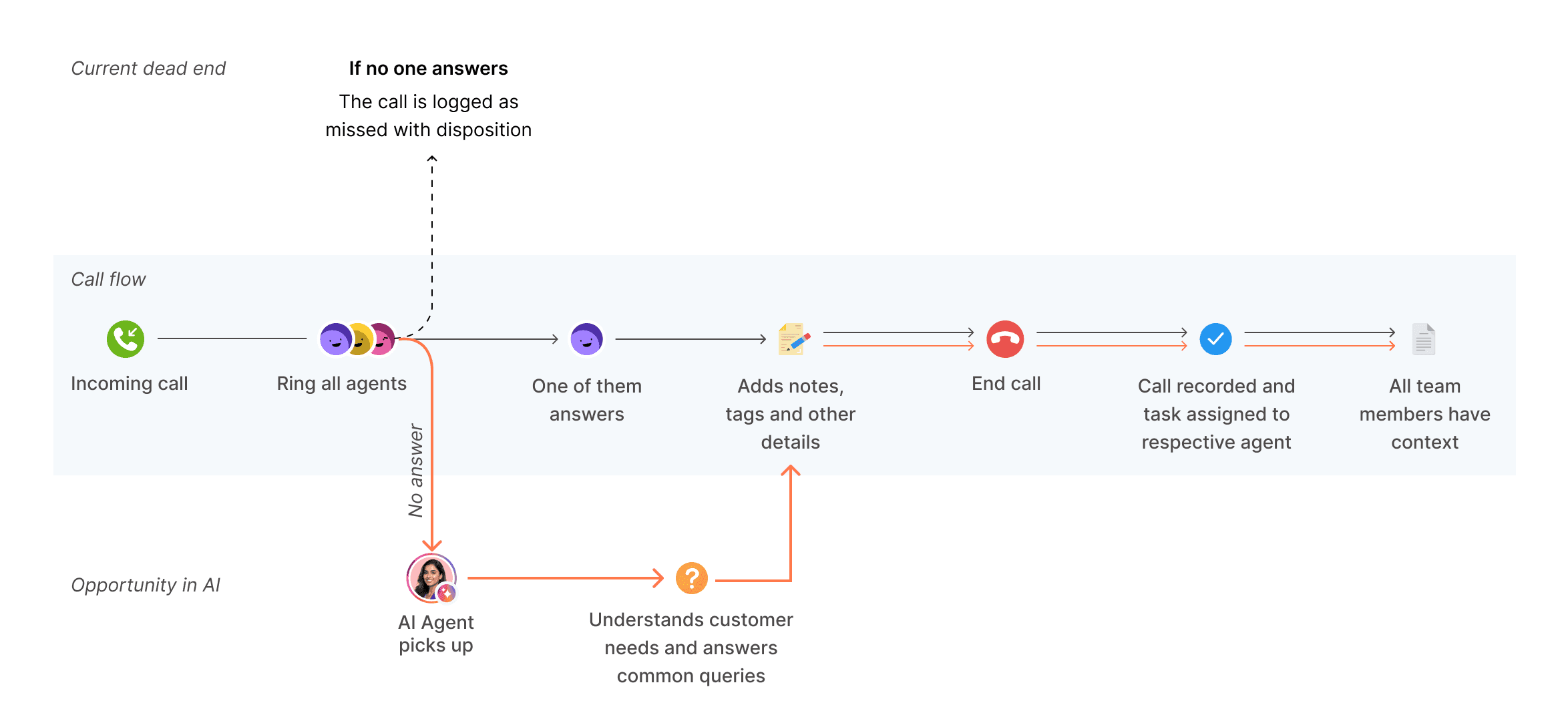
Today, an incoming call rings the team. If someone picks up, the call is handled, logged, and its context is shared with the whole team. If no one answers, the branch ends: the customer gets a missed-call message, and the call log records the miss. That unanswered branch is the dead end this feature exists to close.
Today, an incoming call rings the team. If someone picks up, the call is handled, logged, and its context is shared with the whole team. If no one answers, the branch ends: the customer gets a missed-call message, and the call log records the miss. That unanswered branch is the dead end this feature exists to close.
All the ways a call gets missed
When no one is free
Call volume outstrips the lines available
After business hours
Weekends or Holidays
Single user team
All the ways a call gets missed
When no one is free
Call volume outstrips the lines available
After business hours
Weekends or Holidays
Single user team

Pinch zoom to view
Where AI fits
Where AI fits
AI Agent will handle the unanswered branch
AI Agent will handle the unanswered branch
The agent now takes the "no answer" branch. Instead of ending abruptly, the call is answered: the agent resolves as much as it can, and when a request goes beyond what it should attempt, it transfers to a person with the context rather than guessing.
The agent now takes the "no answer" branch. Instead of ending abruptly, the call is answered: the agent resolves as much as it can, and when a request goes beyond what it should attempt, it transfers to a person with the context rather than guessing.
What it promises the business
Never miss a call. Agent always answers when the team is busy or closed.
Works 24×7. The business stays reachable round the clock.
Always professional. Sounds like a trained receptionist for that business.
Handles the request. Asks the right questions or shares common information.
Frees up the team. Staff focus on in-store customers and higher-value work.
What it promises the business
Never miss a call. Agent always answers when the team is busy or closed.
Works 24×7. The business stays reachable round the clock.
Always professional. Sounds like a trained receptionist for that business.
Handles the request. Asks the right questions or shares common information.
Frees up the team. Staff focus on in-store customers and higher-value work.
Pinch zoom to view
The design problem
The design problem
Setting up AI Agent requires technical skills
Setting up AI Agent requires technical skills
The users are not early adopters. Most have never set up an automation of any kind and are unsure of AI. The agent had to make sense to someone with no mental model for it.
The users are not early adopters. Most have never set up an automation of any kind and are unsure of AI. The agent had to make sense to someone with no mental model for it.
The agent is autonomous. No human is in the conversation while it happens. The owner cannot intervene mid-call to correct any mistakes; the agent interacts with the customer entirely on its own.
The agent is autonomous. No human is in the conversation while it happens. The owner cannot intervene mid-call to correct any mistakes; the agent interacts with the customer entirely on its own.
A bad call costs more than a missed one. A poorly set-up agent can annoy a caller and lose a lead; a wrong answer, said confidently, does real damage. The stakes sit on the business, not the tool.
A bad call costs more than a missed one. A poorly set-up agent can annoy a caller and lose a lead; a wrong answer, said confidently, does real damage. The stakes sit on the business, not the tool.
strategic goal
strategic goal
Give every business a receptionist it can set up itself
Give every business a receptionist it can set up itself
The goal was not to create an agent that could simply engage in conversation. Instead, it was to develop an agent that a business could effectively manage. This agent should be able to handle calls that the team is unable to answer, respond to routine questions efficiently, and be set up and maintained by an owner without any technical skills or anyone else to delegate tasks to.
The goal was not to create an agent that could simply engage in conversation. Instead, it was to develop an agent that a business could effectively manage. This agent should be able to handle calls that the team is unable to answer, respond to routine questions efficiently, and be set up and maintained by an owner without any technical skills or anyone else to delegate tasks to.
For users: every call answered, without hiring, training or managing a person.
For Superfone: prove that a small business will hand real customer calls to AI, and open the path to more agent-led features.
For users: every call answered, without hiring, training or managing a person.
For Superfone: prove that a small business will hand real customer calls to AI, and open the path to more agent-led features.
Principles for introducing AI
Principles for introducing AI
Throughout the project, these three principles guided my design decisions:
Throughout the project, these three principles guided my design decisions:
01
01
Easy setup for non-technical users
Easy setup for non-technical users
Owners shouldn't have to learn how the agent works behind the screen. Setup asks only what they'd tell a new hire about what the business does, what is their job, when it's open, which calls to take.
Owners shouldn't have to learn how the agent works behind the screen. Setup asks only what they'd tell a new hire about what the business does, what is their job, when it's open, which calls to take.
02
02
Agent is a team member
Agent is a team member
The agent functions as a 24/7 coworker. Its persona with voice, name, and personality defines its role as a key representative of the business.
The agent functions as a 24/7 coworker. Its persona with voice, name, and personality defines its role as a key representative of the business.
03
03
Full visibility
Full visibility
Present all interactions in clear language and document every call with summaries, tags, and assigned tasks. It ensures owners have visibility into agent activity and allows for quick access to information for team members.
Present all interactions in clear language and document every call with summaries, tags, and assigned tasks. It ensures owners have visibility into agent activity and allows for quick access to information for team members.
solution
solution
Stage 1 : Add the AI Agent as a member of the team
Stage 1 : Add the AI Agent as a member of the team
Insight
Insight
An autonomous agent raises unique questions standard features don't: when does it respond, and what role does it play for the caller? These can be adjusted into settings, where non-technical owners often struggle.
An autonomous agent raises unique questions standard features don't: when does it respond, and what role does it play for the caller? These can be adjusted into settings, where non-technical owners often struggle.
Opportunity
Opportunity
How might an owner set up the agent using models they already understand, instead of learning new ones?
How might an owner set up the agent using models they already understand, instead of learning new ones?
design hypothesis
design hypothesis
If the AI Agent integrates into existing team structure, the setup becomes a process of adding a member instead of configuring a system
If the AI Agent integrates into existing team structure, the setup becomes a process of adding a member instead of configuring a system
Decision 1
Decision 1
Give the agent a persona
Give the agent a persona
The agent is designed as a named persona, complete with a face, voice, and language that the owner can select from a library of Indic languages. This process also alters the nature of the setup: by naming the agent and choosing its voice, it feels more like introducing a team member rather than simply adjusting a preference.
The agent is designed as a named persona, complete with a face, voice, and language that the owner can select from a library of Indic languages. This process also alters the nature of the setup: by naming the agent and choosing its voice, it feels more like introducing a team member rather than simply adjusting a preference.

Pinch zoom to view
Decision 2
Decision 2
Give the agent a seat in the ringing order
Give the agent a seat in the ringing order
Superfone features a call routing system that allows users to set which phone rings in order. The AI Agent integrates seamlessly into the existing routing pattern inheriting the same rules eliminating the need for reconfiguration.
Superfone features a call routing system that allows users to set which phone rings in order. The AI Agent integrates seamlessly into the existing routing pattern inheriting the same rules eliminating the need for reconfiguration.

Pinch zoom to view
Decision 3
Decision 3
Set the agent's working hours
Set the agent's working hours
Superfone aligns with a business's open and closed hours. During open hours, the agent acts as a backup, while it takes all calls during closed hours. This allows owners to activate the agent only when needed, providing a low-risk way to use AI without impacting current operations.
Superfone aligns with a business's open and closed hours. During open hours, the agent acts as a backup, while it takes all calls during closed hours. This allows owners to activate the agent only when needed, providing a low-risk way to use AI without impacting current operations.

Pinch zoom to view
solution
solution
Stage 2 - Define what the agent knows and what it can do
Stage 2 - Define what the agent knows and what it can do
Insight
Insight
Traditional agent frameworks require writing complex code or configuring messy, unreadable visual node graphs.
Traditional agent frameworks require writing complex code or configuring messy, unreadable visual node graphs.
Opportunity
Opportunity
How can a non-technical user provide an AI agent with useful information and define it’s role with easy setup?
How can a non-technical user provide an AI agent with useful information and define it’s role with easy setup?
design hypothesis
design hypothesis
A framework that uses simple file uploads and structured text prompts to turn business rules into deterministic call workflows.
A framework that uses simple file uploads and structured text prompts to turn business rules into deterministic call workflows.
architecture
architecture
Knowledge and Jobs
Knowledge and Jobs
The goal is to mask complex vector embeddings and API schemas into an intuitive UI that a non-technical manager can deploy advanced voice agents. This process combines functional action design (Jobs) with contextual information retrieval (Knowledge)
The goal is to mask complex vector embeddings and API schemas into an intuitive UI that a non-technical manager can deploy advanced voice agents. This process combines functional action design (Jobs) with contextual information retrieval (Knowledge)
Knowledge
Knowledge
Provides the static reference data that keeps the agent grounded and accurate
Business details, FAQs, products, pricing, shipping and cancellation policies
Provides the static reference data that keeps the agent grounded and accurate
Business details, FAQs, products, pricing, shipping and cancellation policies
Jobs
Jobs
Help users define what the agent should do
Take a message, answer about the business, book an appointment, handle a cancellation, transfer to a person.
Help users define what the agent should do
Take a message, answer about the business, book an appointment, handle a cancellation, transfer to a person.
Decision 4
Decision 4
Knowledge as modular blocks as simple as organising files
Knowledge as modular blocks as simple as organising files
Traditional methods for providing agents with context often rely on a single, large instruction file, making it hard for owners to read and maintain. Instead,
Organised into separate blocks: like Pricing, Shipping Policy, Business Hours, FAQs, etc,.
Selective access controls: The UI uses simple toggle switches to choose which specific knowledge packets are active
Content import options: Manual document uploads such as PDFs and CSVs.
Organised into separate blocks: like Pricing, Shipping Policy, Business Hours, FAQs, etc,.
Selective access controls: The UI uses simple toggle switches to choose which specific knowledge packets are active
Content import options: Manual document uploads such as PDFs and CSVs.


Pinch zoom to view
Decision 5
Decision 5
Defining automated jobs with conversational rules
Defining automated jobs with conversational rules
The goal is to keep the user interface clean and text-driven while preventing the AI from hallucinating during critical tasks.
The goal is to keep the user interface clean and text-driven while preventing the AI from hallucinating during critical tasks.
Intent triggers: The user describes a trigger scenario conversationally. Mid-call, the AI Agent identifies this intent in real time to launch the specific job workflow.
Post-Job Actions: Define the exact actions the AI must carry out such as, data entry or task assignments, once the main job is done.
Intent triggers: The user describes a trigger scenario conversationally. Mid-call, the AI Agent identifies this intent in real time to launch the specific job workflow.
Post-Job Actions: Define the exact actions the AI must carry out such as, data entry or task assignments, once the main job is done.

Pinch zoom to view
Decision 6
Decision 6
Simplifying prompt creation with AI-assisted writing
Simplifying prompt creation with AI-assisted writing
Instead of forcing users to master complex prompt engineering, we allowed them to write freely in the workspace. Under the hood, our AI-assisted module restructures raw, conversational input into a precise, machine-ready format tailored for the AI agent. Detailed case study here.
Instead of forcing users to master complex prompt engineering, we allowed them to write freely in the workspace. Under the hood, our AI-assisted module restructures raw, conversational input into a precise, machine-ready format tailored for the AI agent. Detailed case study here.


Pinch zoom to view
solution
solution
Stage 3 - Transfer call to a human agent
Stage 3 - Transfer call to a human agent
Insight
Insight
The transfer is where an AI agent most often fails a customer. Either it refuses to let go, or it hands over so abruptly that the caller has to explain everything again to a person who knows nothing.
The transfer is where an AI agent most often fails a customer. Either it refuses to let go, or it hands over so abruptly that the caller has to explain everything again to a person who knows nothing.
Opportunity
Opportunity
How might a handoff feel like being introduced to a colleague rather than being passed to a stranger?
How might a handoff feel like being introduced to a colleague rather than being passed to a stranger?
Design hypothesis
Design hypothesis
If AI Agent shares conversation context with the next person, the handoff remains seamless
If AI Agent shares conversation context with the next person, the handoff remains seamless
Decision 7
Decision 7
Assign the transfer destination
Assign the transfer destination
The agent automatically transfers calls when a caller requests assistance or when the agent cannot resolve an issue. Owners set transfer destinations in the call flow settings, ensuring consistency without needing to revisit decisions with each update.
The agent automatically transfers calls when a caller requests assistance or when the agent cannot resolve an issue. Owners set transfer destinations in the call flow settings, ensuring consistency without needing to revisit decisions with each update.

Pinch zoom to view
Decision 8
Decision 8
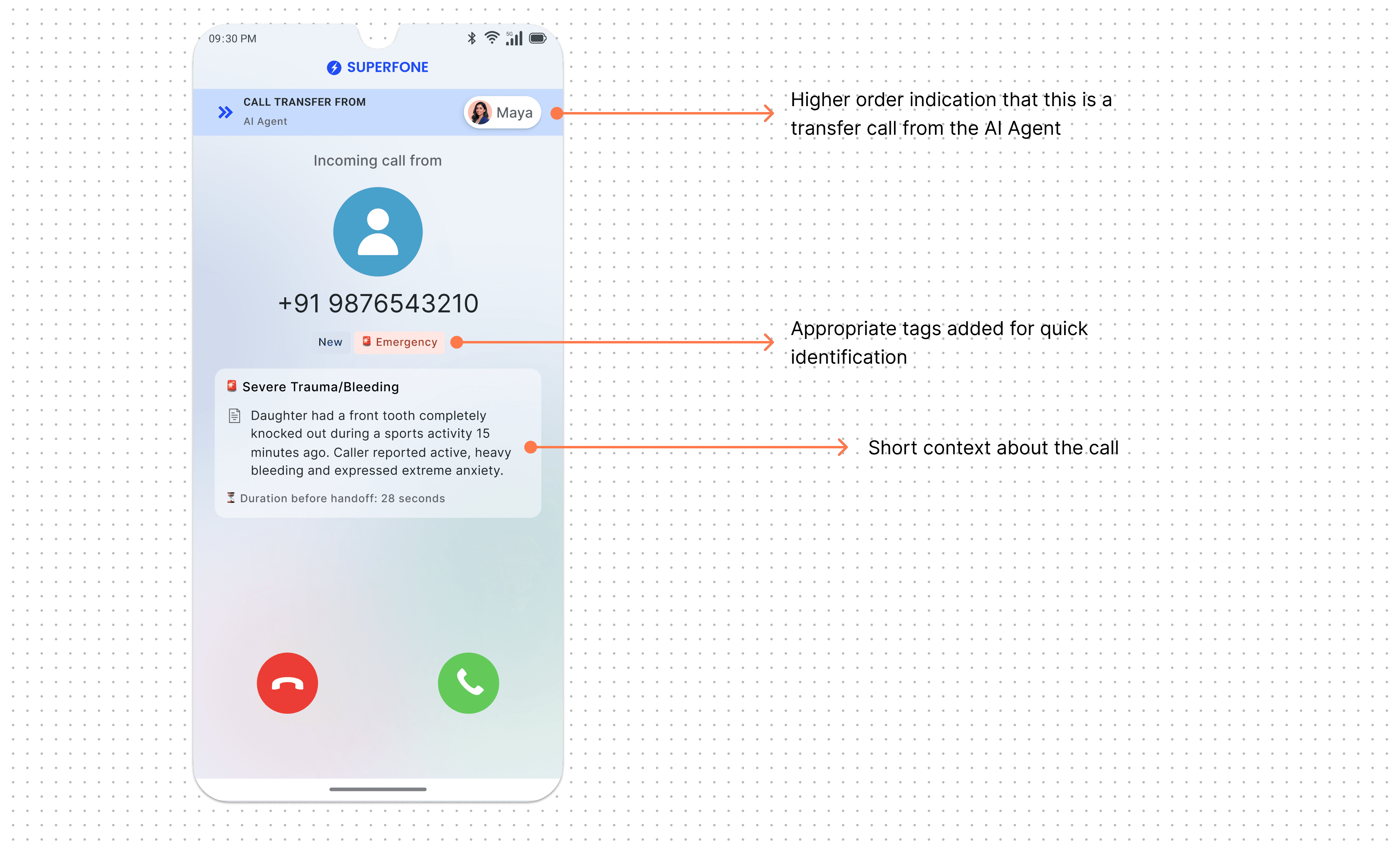
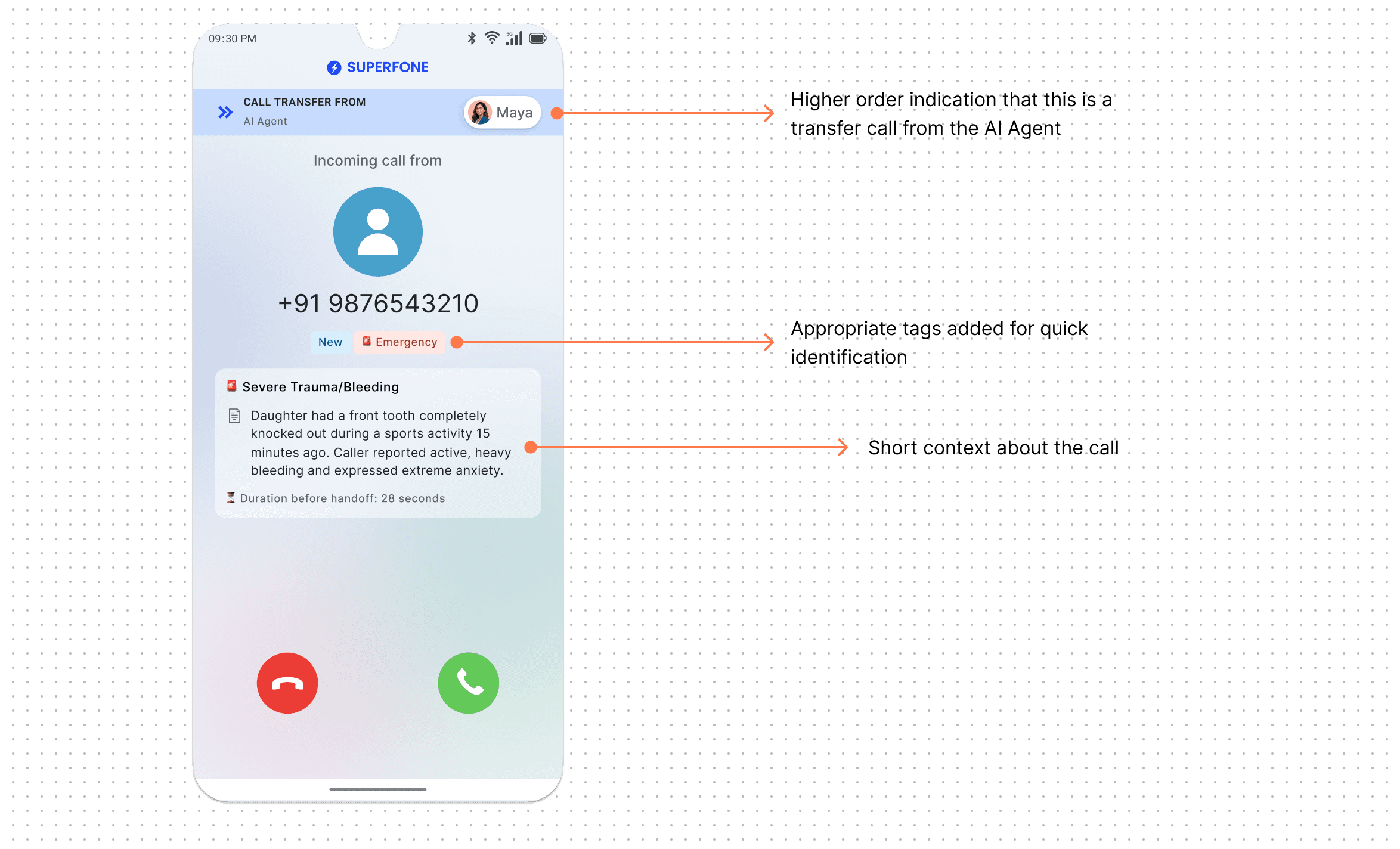
Give the person receiving the transfer call context before they speak
Give the person receiving the transfer call context before they speak
In-app call notification for the targeted human agent.
As the human agent's phone rings, AI Agent generates an instantaneous, structured text summary of the conversation that occurred.
Pinch zoom to view
solution
solution
Stage 4 : Keep the owner in control after the call
Stage 4 : Keep the owner in control after the call
Insight
Insight
The owner can't sit inside a live call, so control can't depend on watching calls happen. It has to come afterwards, from a record clear enough to act on.
The owner can't sit inside a live call, so control can't depend on watching calls happen. It has to come afterwards, from a record clear enough to act on.
Opportunity
Opportunity
How might an owner stay in control of calls they never heard?
How might an owner stay in control of calls they never heard?
Design hypothesis
Design hypothesis
If AI Agent‘s calls are logged similarly to a team member’s, the owners can hold agent accountable without needing to supervise them.
If AI Agent‘s calls are logged similarly to a team member’s, the owners can hold agent accountable without needing to supervise them.
Decision 9
Decision 9
Log the agent's calls like a team member's
Log the agent's calls like a team member's
The agent's calls are recorded in the same call history as everyone else's, linked to the same customer, with recordings and summaries included. Resolved calls are logged as handled instead of missed, and the agent has its own filter and marker for easy performance review.
The agent's calls are recorded in the same call history as everyone else's, linked to the same customer, with recordings and summaries included. Resolved calls are logged as handled instead of missed, and the agent has its own filter and marker for easy performance review.
Unified Call History: Call recordings and summaries are integrated into the logs for each phone number.
No Missed Call Penalties: Fully resolved calls by the AI agent are noted as successful interactions, rather than missed calls.
Team Collaboration Tools: Superfone facilitates simultaneous review and action on Sona’s logs by multiple staff members.
Unified Call History: Call recordings and summaries are integrated into the logs for each phone number.
No Missed Call Penalties: Fully resolved calls by the AI agent are noted as successful interactions, rather than missed calls.
Team Collaboration Tools: Superfone facilitates simultaneous review and action on Sona’s logs by multiple staff members.

Pinch zoom to view
Decision 10
Decision 10
Summarise the call into something actionable
Summarise the call into something actionable
Instant summarisation: Output a structured set of AI Call Summary directly below the recording playback bar.
Concise call summary: A high-level overview detailing the core reason for the call and what information was shared.
Next steps: Actionable items extracted from the conversation to tell the team exactly what follow-up task is required next

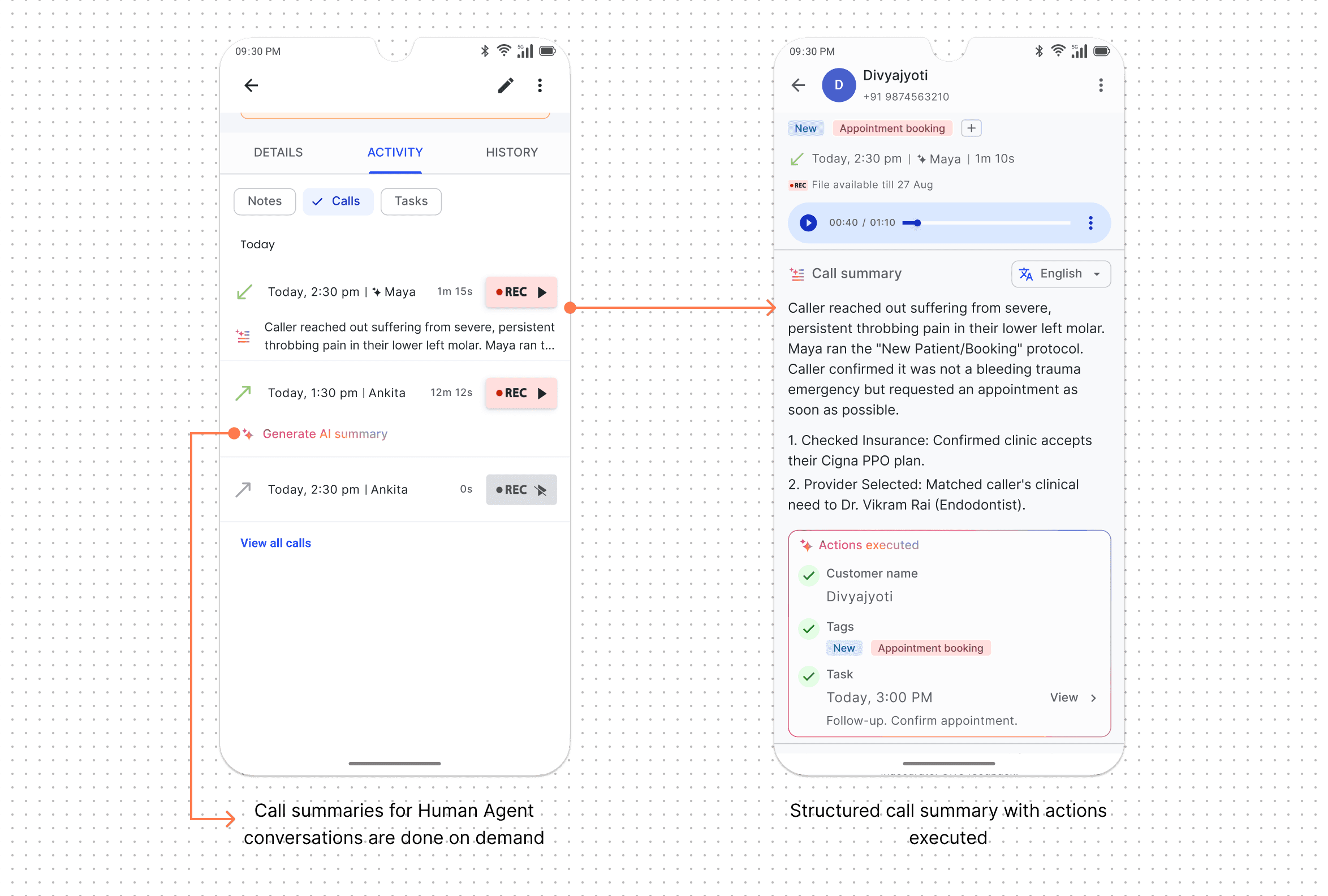
Pinch zoom to view
IMPACT
IMPACT
AI Agent engaged every caller, closing the critical “missed call” revenue leak.
AI Agent engaged every caller, closing the critical “missed call” revenue leak.
The design includes the instrumentation to judge it, because an agent handling calls unattended can't be evaluated on usage alone.
The design includes the instrumentation to judge it, because an agent handling calls unattended can't be evaluated on usage alone.
01
01
Calls answered that would have been missed
Calls answered that would have been missed
The agent's calls logged as handled rather than missed, against the missed-call baseline. The dead end this feature exists to close.
The agent's calls logged as handled rather than missed, against the missed-call baseline. The dead end this feature exists to close.
02
02
Transfer rate, and what triggered it
Transfer rate, and what triggered it
how often the agent hands off, and whether it was a caller asking for a person or the agent reaching its limits. A rising rate of the second means the knowledge base has gaps.
how often the agent hands off, and whether it was a caller asking for a person or the agent reaching its limits. A rising rate of the second means the knowledge base has gaps.
03
03
Return to refine
Return to refine
owners who come back to edit knowledge or jobs after going live. The signal that an owner is managing the agent rather than leaving it running.
owners who come back to edit knowledge or jobs after going live. The signal that an owner is managing the agent rather than leaving it running.
04
04
Owner sentiment on the agent, and on individual summaries
Owner sentiment on the agent, and on individual summaries
the thumbs up/down on the agent overall, and per-summary feedback for accuracy.
the thumbs up/down on the agent overall, and per-summary feedback for accuracy.
05
05
Support Reduction
Support Reduction
Lower volume of customer setup tickets due to the intuitive sandbox testing interface.
Lower volume of customer setup tickets due to the intuitive sandbox testing interface.
Inbound lead capture rate after business hours
Inbound lead capture rate after business hours
Before
Before
68% ended in missed opportunities
68% ended in missed opportunities
After
After
92% successfully answered and converted into logged tickets
92% successfully answered and
converted into logged tickets
72%
72%
containment rate
containment rate
Only 18% of transfers were due to agent limits, and 10% were escalations.
Only 18% of transfers were due to agent limits, and 10% were escalations.
91%
91%
"thumbs-up" approval rating
"thumbs-up" approval rating
on post-call summary notes accuracy and overall satisfaction.
on post-call summary notes accuracy and overall satisfaction.
42%
return to refine
within the first 14 days of going live.
42%
return to refine
within the first 14 days of going live.
reflection
reflection
Integrating AI within familiar user environments significantly enhances its adoption.
Integrating AI within familiar user environments significantly enhances its adoption.
When introducing a new AI feature, the instinct may be to create a separate interface with its own settings and management options. While this approach reflects the novelty of the technology, it can create a steep learning curve for users, particularly those who may not be technically inclined or familiar with AI systems.
While this integration can be challenging and may limit the potential of the AI, it ultimately leads to greater user engagement. By enhancing existing experiences rather than overhauling them, we increase the likelihood that users will embrace and benefit from the new technology.
When introducing a new AI feature, the instinct may be to create a separate interface with its own settings and management options. While this approach reflects the novelty of the technology, it can create a steep learning curve for users, particularly those who may not be technically inclined or familiar with AI systems.
While this integration can be challenging and may limit the potential of the AI, it ultimately leads to greater user engagement. By enhancing existing experiences rather than overhauling them, we increase the likelihood that users will embrace and benefit from the new technology.
credits
credits
Role & Team
Role & Team
Sole product designer.
Owned end-to-end design from problem framing through final QA.
Worked closely with the co-founder on product strategy and direction
Owned all UX-side technical decisions
Influenced the reframing of the problem and the key design decisions.
Ran design critiques with cross-functional stakeholders
Took an active role in QA, including adversarial testing of AI outputs
partnered with engineering through implementation
and, ofcourse, the design implementation :)
Sole product designer.
Owned end-to-end design from problem framing through final QA.
Worked closely with the co-founder on product strategy and direction
Owned all UX-side technical decisions
Influenced the reframing of the problem and the key design decisions.
Ran design critiques with cross-functional stakeholders
Took an active role in QA, including adversarial testing of AI outputs
partnered with engineering through implementation
and, ofcourse, the design implementation :)
Team Worked closely with the co-founder · 3 QA · 2 frontend engineer · 1 backend engineer
Team Worked closely with the co-founder · 3 QA · 2 frontend engineer · 1 backend engineer

Let's talk!
Let's talk!
Have thoughts on this case study, or working on something similar? I'd love to hear from you.
Have thoughts on this case study, or working on something similar? I'd love to hear from you.
shailaja.riva@gmail.com
shailaja.riva@gmail.com